“Now, no matter what the mullah teaches, there is only one sin, only one. And that is theft. Every sin is a variation of theft.” – Khaled Hosseini, The Kite Runner

In 1989, Thai laborer Kriangkrai Techamong was working at the palace of Saudi Prince Faisal bin Fahd in Riyadh. His primary responsibility was tending the palace grounds and gardens. Occasionally, he was brought indoors to complete janitorial duties, giving him access to the prince’s bedroom.
Throughout his stay in Riyadh, Techamong had begun gambling with other migrant workers at the palace, and, by summer, his debts had grown severe. He was desperate to get rid of them. So, when Prince Faisal bin Fahd and his family left Riyadh for a three-month vacation, Techamong took the opportunity to gradually steal the prince’s jewelry and precious gems, hiding them in a large vacuum cleaner bag.
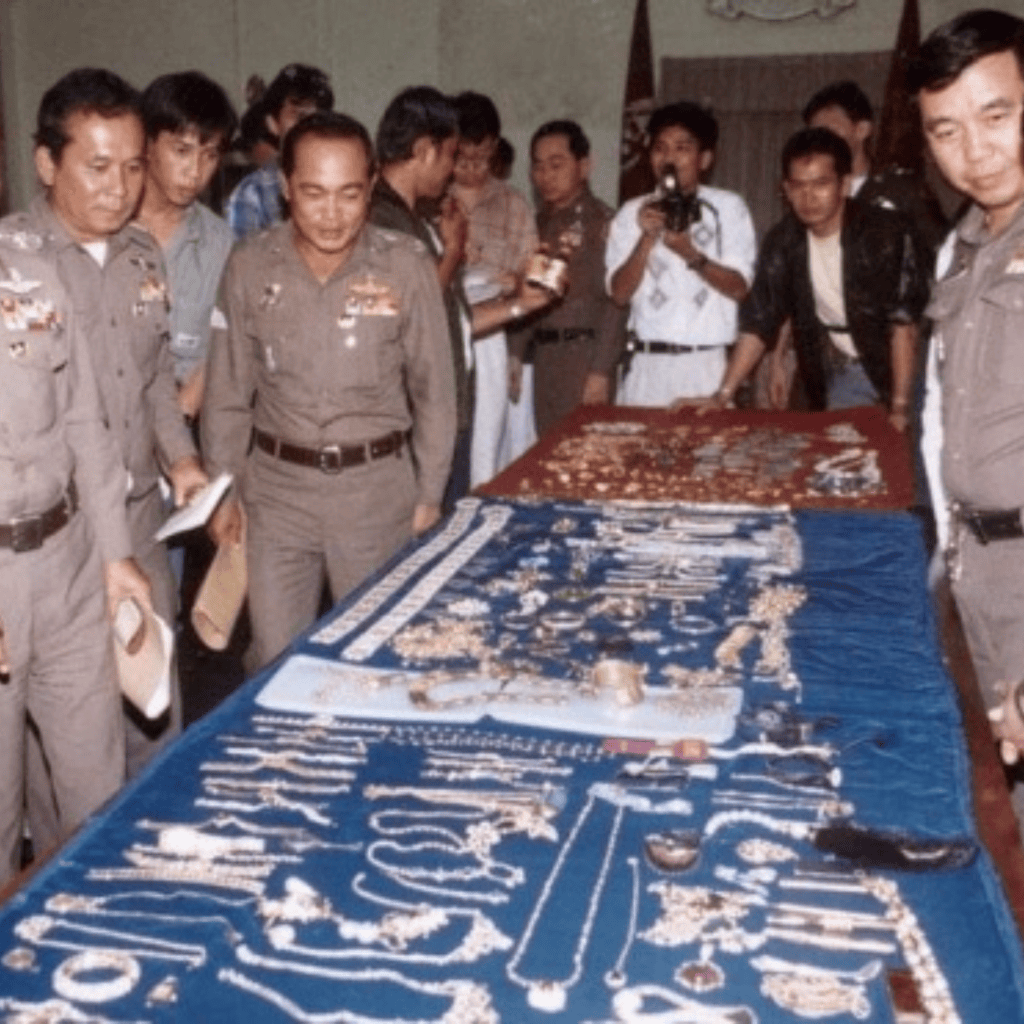
By the time he decided to ship the stolen items, Techamong had accumulated approximately 200 pounds of loot worth over $20 million, with a rare 50-carat blue diamond being the most precious item among his stash. He shipped the items to his home in Lampang Province, Thailand. To avoid the package being searched or flagged by customs officials, Techamong allegedly attached a hefty bribe to the parcel. He quit his job, taped the few remaining stolen gems to his body, and fled Saudi Arabia when he got confirmation of the package’s safe delivery. Upon his arrival home, Techamong sold the gems for a fraction of their worth. Bangkok jeweler Santhi Srithanakhan bought most of them.
Naturally, an investigation – led by Lieutenant-General Chalor Kerdthes – by the Royal Thai Police was opened into the theft of the royal jewels. Additionally, a businessman with connections to the Saudi Royal Family named Mohammad al-Ruwaili travelled to Bangkok to investigate on his own.
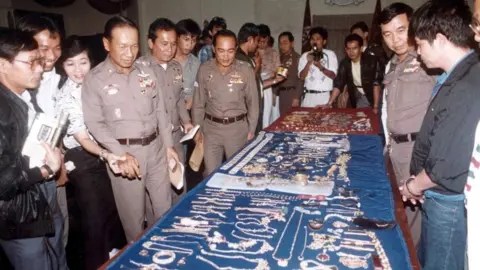
On January 10, 1990, Kriangkrai Techamong was arrested. He was sentenced to seven years in prison; however, he was released after three years due to his confession and cooperation with the police. According to Thai officials, most of the stolen jewelry was recovered.
On February 1, three Saudi diplomats investigating the theft were murdered in an execution-style manner in Thung Mahamek in Bangkok’s Yan Nawa District. The three murders remain unsolved, but U.S. and Saudi intelligence favored the theory that they were assassinated by Saudi Hezbollah, an Iran-backed militant group.
At the time, Saudi Arabia and Iran were engaged in a proxy war. War between Iran and Iraq broke out in 1980 when Iraqi dictator Saddam Hussein launched a full-scale invasion of Iran. Throughout the conflict, Saudi Arabia backed Hussein with billions of dollars in an effort to prevent Iran from exporting their Islamic revolution. This decision caused profound resentment from Tehran.
In July 1987, Iranian pilgrims clashed with Saudi security forces in Mecca during a staged political demonstration. Over 400 people were killed; most of the victims were Iranian. In Tehran, angry mobs broke into the Saudi embassy, leading Saudi Arabia to completely sever ties with Iran in 1988.
The war between Iran and Iraq ended in 1988, but in September, Saudi Arabia executed several Shiite militants who had been convicted of bombing Saudi oil infrastructure. This resulted in Saudi Hezbollah declaring war on the Saudi government and launching a global assassination campaign targeting Saudi diplomats.
Despite this theory, the Saudi Royal Family suspected that corruption within the Thai police force was the real motive. They believed that the three diplomats found damning evidence regarding the specific Thai officials who had pocketed the jewels and were killed because of this.
On February 12, Mohammad al-Ruwaili went missing and is presumed to have been murdered. His body has never been found; however, the Saudi government believes that his body was burned in Thailand’s Chon Buri Province.
The following month, Lieutenant-General Chalor Kerdthes and his investigative team flew to Riyadh to return the stolen gems. Saudi authorities, however, discovered that not only had the blue diamond been missing but about half of the gems were glass replicas as well. Once the Saudi findings were announced, rumors in Thailand began to spread that photos from charity galas and state events captured wives of government officials wearing new, extravagant pieces of jewelry that bore a resemblance to the stolen jewels. These rumors fueled Saudi suspicions that Thai police and high-society individuals had taken the jewels for themselves.
As a result, Saudi Arabia recalled its ambassador from Bangkok and refused to appoint a new one. Their embassy remained open, but with the lowest tier of diplomatic leadership. The Saudi government banned its citizens from traveling to Thailand for tourism, while Thai citizens were barred from visiting Saudi Arabia except for religious pilgrimages. Saudi Arabia also stopped issuing new work visas to Thai nationals.
Before the ban, more than 200,000 Thais worked in Saudi Arabia, sending home massive financial remittances. By 2008, this plummeted to less than 10,000. Thailand’s medical and luxury tourism sectors lost hundreds of millions of dollars due to the Saudi ban on affluent travelers. Altogether, Thailand lost $7 billion in revenue between 1990 and 2022.
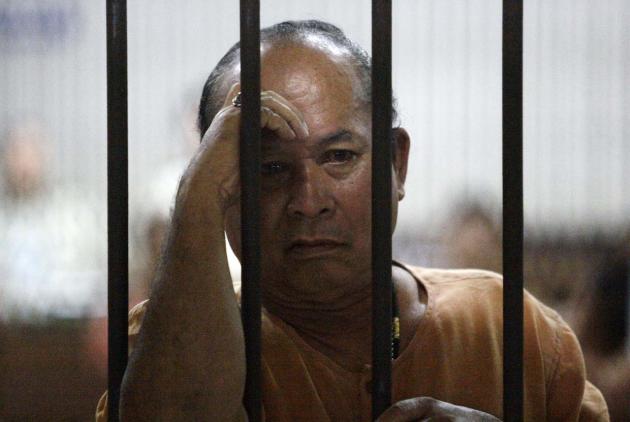
In 1993, Lieutenant-General Chalor Kerdthes and seven associates were formally charged with corruption, jewelry embezzlement, and extorting millions of Thai baht from Santhi Srithanakhan.
Independent investigators found that the group was operating an organized crime ring within the police department to hide the stolen goods and extort local dealers. The group allegedly pocketed roughly 80% of the true multi-million-dollar haul and ordered the creation of the glass replicas. Chalor, according to investigators, falsified police records to state that the entirety of the stolen items had been recovered and returned. The group was also accused of abducting Srithanakhan to force him into turning over any authentic pieces he had bought, with Kerdthes being accused of extorting 4.86 million Thai baht from him.
Santhi Srithanakhan’s wife and fourteen-year-old son were kidnapped and murdered in July 1994. Chalor Kerdthes was also charged with ordering these murders.
In December 2002, Kerdthes was found guilty of premeditated murder, extortion, and kidnapping for ordering the two murders. He was sentenced to life in prison. Upon an appeal by the prosecution, in March 2006, an appeals court upgraded Kerdthes’s conviction by sentencing him to death.
Chalor Kerdthes was found guilty of malfeasance, embezzlement of state-seized property, and abuse of authority in a trial regarding the original 1993 charges. He was sentenced to an additional twenty years.
All of his guilty verdicts were upheld by the Supreme Court of Thailand in October 2009, finalizing his death sentence for the double murder.
On January 12, 2010, five police officers were charged with the abduction and murder of Mohammad al-Ruwaili. The officers were acquitted on March 31, 2014, and their acquittals were permanently upheld by the Supreme Court on March 22, 2019. The death of Mohammad al-Ruwaili remains unsolved.

In December 2011, despite his death sentence, Thailand’s King Bhumibol Adulyadej reduced Chalor Kerdthes’s sentence to 50 years’ imprisonment via a royal pardon. It was formalized as part of a collective royal amnesty marking the King’s 84th birthday.
In Thailand, major royal milestones are traditionally observed with sweeping clemency decrees that commute the sentences of prisoners nationwide. This tradition is rooted in the Buddhist framework of the Dhamma Raja (Righteous King). The core duty of a righteous ruler is to govern with compassion. So, granting amnesty is considered to be an ultimate act of grace and forgiveness. This tradition also serves to reduce prison populations, since Thailand does have one of the highest incarceration rates globally.
Ultimately, Kerdthes was released in 2013 because of his deteriorating condition: he was 70 and suffering from severe, debilitating health conditions, which included progressive paralysis.
On March 16, 2016, Kriangkrai Techamong announced to reporters in front of his home in Lampang Province that he was going to become a Buddhist monk to repent for his dishonest actions. He told the reporters that he believed the Saudi blue diamond was cursed and claimed its theft had brought a series of calamities upon him and his family. His ordination took place the following day with Kerdthes present.
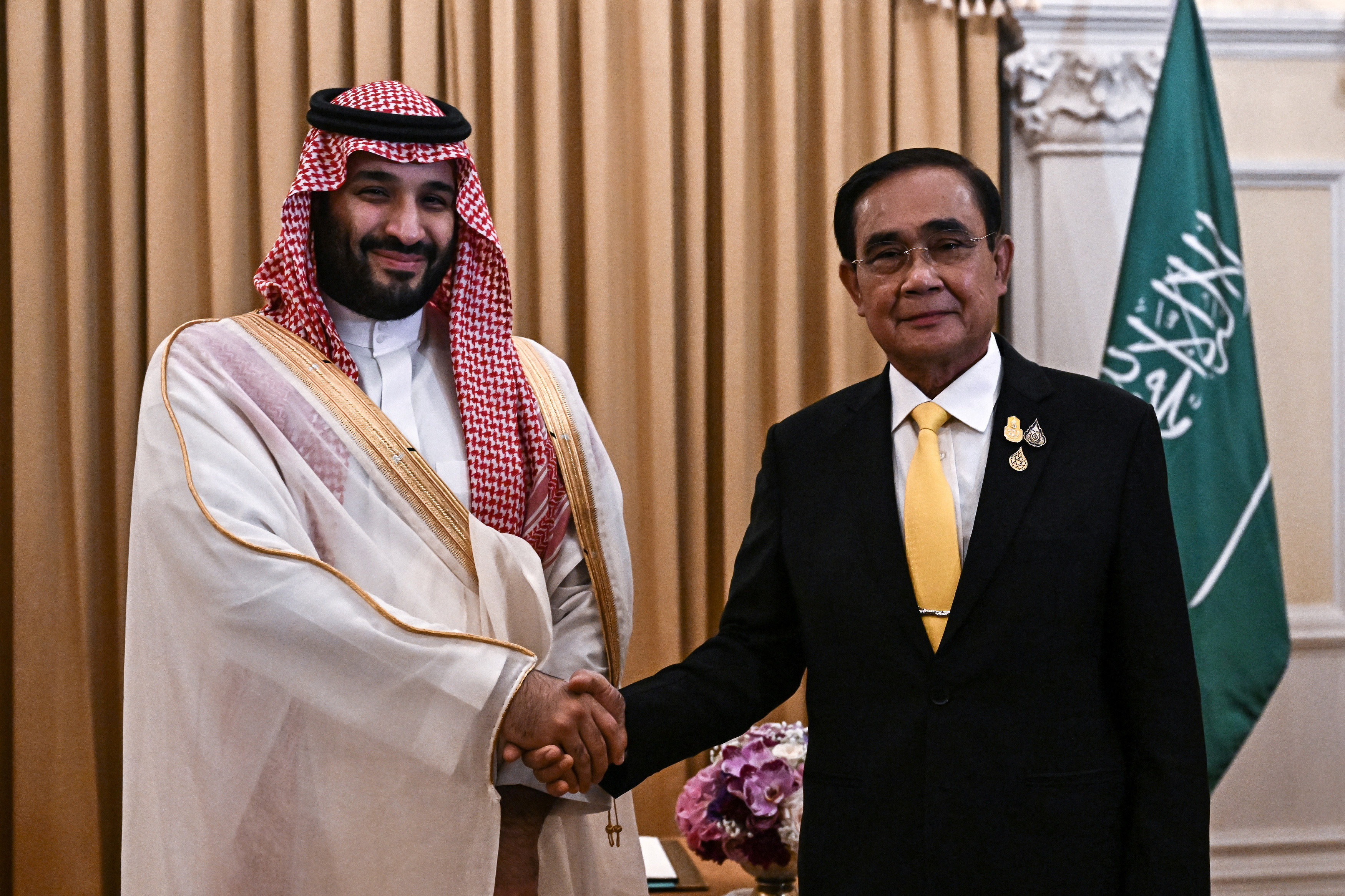
On January 25, 2022, Saudi Crown Prince Mohammed bin Salman and Thai Prime Minister Prayut Chan-o-cha met in Riyadh to end the three-decade diplomatic freeze.
The two nations officially restored full diplomatic relations, resumed direct flights, and renewed labor and economic ties. Thailand’s automotive sector saw a boost, with exports of cars and vehicle parts to Saudi Arabia surging by 40-50%. Within two years of reconciliation, the bilateral trade between the two countries rapidly climbed to $8.8 billion. Thailand also opened its first formal Board of Investment office in Riyadh to facilitate joint ventures in agriculture, renewable energy, and technology.
Additionally, there was a threefold increase in Saudi tourists visiting Thailand, increasing revenue significantly in Thailand’s hospitality and wellness sectors.
The rare 50-carat blue diamond remains missing. Theories of where it’s gone include it being among the Thai elite, it being cut into smaller stones and sold on the black market, while top Thai investigators claim there isn’t any evidence that the blue diamond even existed.


Leave a Reply